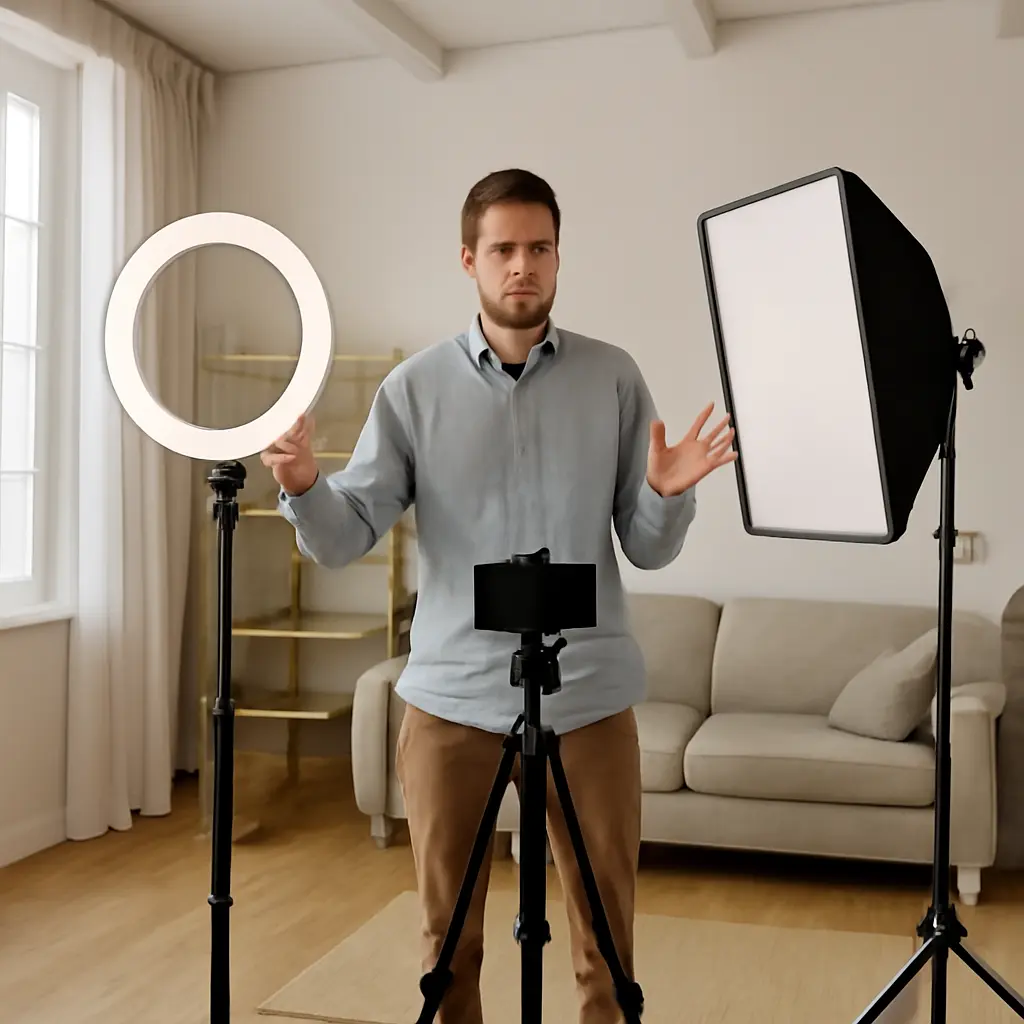
A ring light is a circular light source that surrounds a phone or camera, while a softbox is a diffused light enclosed by a fabric-covered frame. For phone shots, neither wins in every situation: a ring light is usually the quicker choice for centered, close-up portraits and creator videos, while a softbox generally gives more natural-looking, directional light for portraits, product images, and varied setups. The difference comes down to light size, distance, direction, and control—not simply brightness. This guide compares how each light shapes a face, performs on camera, fits different uses, and affects cost and setup.
How ring lights and softboxes shape phone-shot lighting
Lighting quality describes how a light’s size and position affect the brightness, contrast, and softness of shadows on a subject. Photographer and educator Strobist’s David Hobby emphasizes the importance of the light’s apparent size: a source appears larger to a subject when it is physically larger or placed closer. That principle applies to both ring lights and softboxes, so the label alone does not determine whether the result looks soft.
A ring light is a circular source, often used near the phone lens. Its close, frontal placement can reduce harsh facial shadows and create a recognizable ring-shaped reflection in the eyes. A softbox spreads light through a diffuser and is commonly positioned off to one side. That direction can create more dimensional shading, though a small or distant softbox may still produce hard-looking shadows.
Ring-light lighting: frontal and convenient
A ring light places illumination around the lens, keeping the light and camera close to the same axis. This can make it easy to light a talking-head video or makeup demonstration without complex positioning. The trade-off is comparatively flat lighting: because the light comes from near the camera, it may reveal less shape in the face than a source placed to the side.
The circular catchlight is another recognizable feature. It may suit beauty content, but it can look conspicuous in reflective glasses, glossy products, or close-up portraits. A phone mounted in the center of a ring can also require repositioning if the ring’s reflections or frame interfere with the shot.
Softbox lighting: diffused and directional
A softbox is a modifier that spreads a light source through one or more diffusion layers. When placed near a subject, its broad illuminated surface can soften shadow transitions. Positioned to the side, it can add facial or product dimension; adding a reflector on the opposite side can gently lift the shadows without eliminating all contrast.
Softboxes come in different shapes and sizes, including rectangular, square, and octagonal designs. A larger model can create broad, soft light, but it occupies more space and may need a separate lamp, stand, and power source. For a phone creator working at a desk, a small softbox can be a useful compromise between control and footprint.
Which light performs better for phone shots?
The better choice depends on the shot’s purpose, the available space, and how much control the creator wants. A ring light is often faster to position for a single person facing the phone. A softbox is generally more flexible when the subject needs shaping, when the phone is shooting objects, or when a more natural side-lit look is desired. In either setup, moving the light closer can make it appear larger and softer, while changing its angle changes the direction of shadows.
Selfies, video calls, and talking-head videos
For a centered face-to-camera shot, a ring light is usually the easiest starting point. It illuminates the face from near the camera axis and can reduce prominent shadows under the eyes or nose. A softbox can also work well, especially when placed slightly above and to one side of the phone for a more dimensional result. For a simple, evenly lit video-call look, choose the ring; for a more shaped portrait, try the softbox.
Makeup, skincare, and close-up portraits
A ring light is useful for close-up beauty demonstrations because its frontal illumination makes facial details easy to see and its circular catchlights are familiar in beauty content. However, even illumination does not guarantee accurate color: the light’s color quality and the phone’s automatic white balance also matter. For portraits intended to look more natural or dimensional, a softbox placed at an angle is often preferable. Check the result on the phone screen, especially if glasses or shiny cosmetics create distracting reflections.
Product photography and tabletop shots
A softbox often wins for products because its direction and distance can be adjusted to reveal shape, texture, and edges. For a reflective item such as a bottle or polished case, the product may reflect the shape of the light itself; rotating or moving the softbox can therefore change the highlight substantially. A ring light can provide convenient, even illumination for quick catalog-style images, but its circular reflection may be visible on glossy packaging. A white card or reflector can help fill shadows in either setup.
Small rooms, travel, and quick setup
A compact ring light with a phone mount is generally the simpler portable option: it combines the light and phone support in one arrangement. A softbox typically requires a light stand and a separate light, which can take more room to position and store. Small softboxes and portable LED panels can reduce that burden, but buyers should compare the complete kit—not just the modifier—when assessing portability.
What to compare before buying a ring light or softbox
Product descriptions often emphasize wattage, brightness, or color modes, but those figures do not alone predict flattering results. Compare the light’s size, diffusion, color quality, adjustability, and practical distance from the subject. The phone itself also affects the outcome: automatic exposure and white balance can change the appearance of a scene as lighting changes.
Size, distance, and diffusion
A light’s apparent size from the subject’s viewpoint helps determine shadow softness. Bringing a light closer generally makes it appear larger, but it also makes illumination fall off more quickly across the scene. A small ring light placed close to a face can be flattering for a tight shot, while a larger softbox close to the subject can provide broader, softer illumination. If a softbox is placed far away, its apparent size shrinks and its light may look less soft.
Color quality, brightness, and phone exposure
Color quality matters when skin tones, food, clothing, or product colors need to look credible. The U.S. Department of Energy explains that the color rendering index (CRI) is a measure of how accurately a light source reveals colors compared with a reference source; CRI is useful as a comparison, but it does not describe every aspect of color quality. When shopping, look for clear color-rendering specifications and consistent color across brightness settings rather than relying only on a “daylight” label.
Brightness should be adjustable so the phone does not have to compensate excessively by raising exposure or altering the image. If the face looks washed out, reduce the light or move it farther away; if the background becomes too dark, adjust the room lighting or use a reflector. Locking exposure and white balance where the phone app allows it can help keep a video’s appearance consistent.
Power, stands, and practical control
A ring light may offer a built-in phone holder and adjustable color temperature, while a softbox kit may require separate choices for the lamp, modifier, stand, and diffuser. Check whether the light is powered by USB, a battery, or mains electricity, and whether the stand can safely support the phone or modifier. For filming, also consider flicker performance: a light that appears steady to the eye may show bands or pulsing on camera at certain settings or frame rates.
A practical phone-lighting test and setup
A short side-by-side test is more useful than choosing by product category alone. Keep the phone, subject, framing, and room conditions the same, then compare a ring light and softbox at similar apparent brightness. A simple comparison chart could record shadow softness, catchlight shape, glare, skin-tone appearance, background brightness, and setup time for each option.
- Place the phone at eye level and frame the shot before adjusting the light.
- Position the light near the phone for a centered look, then move it off-axis to see how the shadows change.
- Adjust the light’s distance and brightness rather than relying only on the phone’s automatic exposure.
- Check reflections in glasses, shiny skin, and glossy objects; reposition or diffuse the source if needed.
- Record a short clip and inspect it for color shifts, exposure changes, and flicker.
For a beauty tutorial, a creator might begin with a ring light centered around the phone, then compare it with a softbox placed at roughly a 45-degree angle. The ring light will typically give a more frontal, even appearance; the softbox can create more visible contour and shadow. For a reflective skincare bottle, the creator can rotate the softbox until its highlight looks intentional, or use the ring light if a fast, even product image matters more than shaping the reflection.
Conclusion: ring light versus softbox for phone shots
A ring light is the convenient winner for centered selfies, video calls, and quick beauty content. A softbox is the more adaptable choice for dimensional portraits, product photography, and scenes where controlled direction matters. Both can produce soft light when appropriately sized and positioned; neither guarantees good color or flattering exposure on its own. Start with the kind of phone shot you make most often, test the light in your actual space, and choose the setup that gives you the look you want with the least friction.
For further improvement, compare sample frames in your phone’s camera app and learn how light direction changes shadows before spending more on equipment. A well-placed, affordable light is often more useful than a more expensive one that is too far away, too bright, or difficult to position.
Sources: Strobist, Lighting 101: The Basics of Small Strobe Lighting, https://strobist.blogspot.com/2006/03/lighting-101.html; U.S. Department of Energy, Solid-State Lighting: Color Rendering Index (CRI), https://www.energy.gov/eere/ssl/color-rendering-index-cri; National Institute of Standards and Technology, Color Quality Scale (CQS), https://www.nist.gov/programs-projects/color-quality-scale-cqs