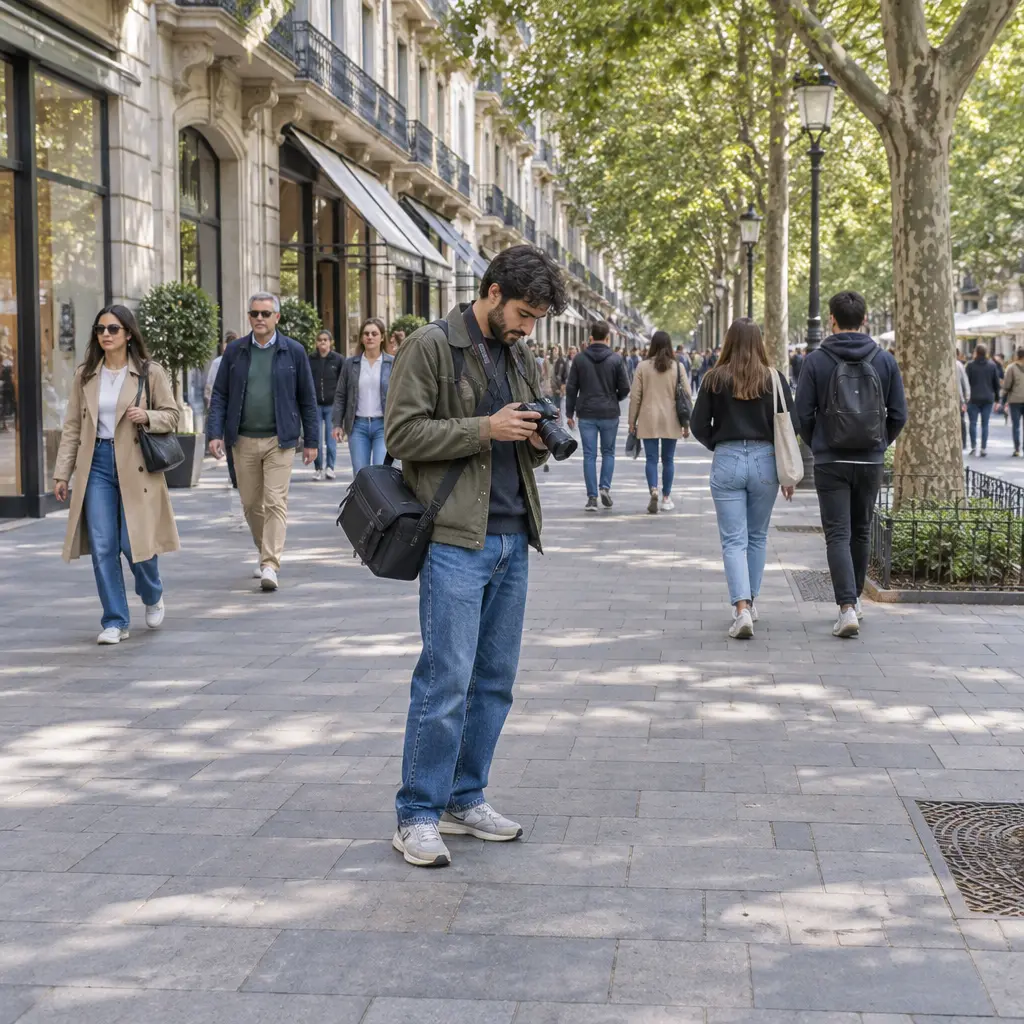
Street photography ethics balances candid timing with respect for the people pictured. Candid photography records unposed moments in public life, but being legally permitted to make an image does not automatically make every photograph considerate or fair to publish. The National Press Photographers Association’s ethics code calls on visual journalists to treat subjects with respect and dignity, while research on photography and privacy shows that expectations can vary with context, vulnerability, and how images are used. A practical approach is to assess the setting, the subject’s vulnerability, the image’s likely impact, and whether consent or a change in approach is warranted—without assuming that a camera’s presence erases a person’s dignity.
Candid Timing and Street Photography Ethics
Street photography ethics are the principles used to make and share images of people in public or publicly accessible spaces while considering their rights, dignity, safety, and the photographer’s purpose. There is no single rule that resolves every situation: laws differ by location, and ethical judgment extends beyond legality. The NPPA code, for example, advises photographers to show compassion for people affected by images and to avoid contributing to stereotypes or harm. These principles matter because a fleeting moment can become a permanent, searchable image once published or shared online.
The scale of photography makes thoughtful choices relevant beyond professional journalism. In its 2024 report, DataReportal estimated that 5.22 billion people used social media worldwide in January 2024. That figure describes platform identities, not necessarily unique individuals, but it illustrates how quickly an image can circulate through connected services. A photograph made in seconds may be copied, recaptioned, or separated from its original context for years.
Respect for Subject Dignity Defines Ethical Street Photography
Subject dignity in photography means treating a person as more than visual material: considering their agency, circumstances, privacy expectations, and exposure to harm. The NPPA’s Code of Ethics does not provide a universal legal definition of dignity; instead, it offers professional guidance, including showing respect and compassion, considering the consequences of publication, and giving people an opportunity to speak when appropriate. Those ideas provide a workable ethical test for candid images: does the photograph illuminate a meaningful moment, or does it mainly turn someone’s vulnerability into spectacle?
Dignity is shaped by context. A person laughing with friends, a demonstrator addressing a crowd, and someone in visible distress may all be photographed in public, but the consequences of exposure are not equivalent. Ethical practice therefore distinguishes among ordinary candid observation, public-interest documentation, and images that expose sensitive circumstances. These categories overlap; they are not automatic permissions or prohibitions.
Ordinary Candid Moments and Context
An ordinary candid moment is an unposed interaction recorded without directing the subjects. Its ethical significance depends partly on what the scene communicates and how the image is framed. A photograph of a crowded market, for instance, may document community life, while a tight crop that singles out one passerby can imply a story the photographer does not know to be true. Accurate captions and context help prevent viewers from treating a momentary expression as proof of a person’s character or circumstances.
Vulnerability, Distress, and Unequal Power
Vulnerability describes a situation in which a person may have reduced ability to understand, refuse, or control the consequences of being photographed. Distress, illness, homelessness, intoxication, grief, childhood, or an imbalance between the photographer and subject can raise the stakes. The NPPA code specifically urges sensitivity when photographing people affected by tragedy or grief. This does not mean such images should never be made: documentation may serve a strong public interest. It does mean the photographer should weigh the image’s informational value against foreseeable harm, avoid humiliating angles or captions, and consider whether identifying details are necessary.
Public Interest and Public Curiosity
Public interest refers to information that helps people understand matters of civic importance, such as a protest, public policy, or the conduct of public institutions. Public curiosity is simply an audience’s desire to see an image. The distinction matters: a photograph may be compelling without contributing meaningful information. When a person’s identity or private hardship is not essential to the story, a wider frame, an anonymous presentation, or a decision not to publish may preserve the documentary value while reducing unnecessary exposure.
Candid Timing Requires Proportionate Consent and Care
Candid timing is the practice of recognizing and photographing an unposed moment as it unfolds. Its value lies in preserving spontaneous gestures, relationships, and public events, but speed does not remove the photographer’s responsibility to judge what is being recorded. The ethical question is not simply “Can I take this picture?” but also “What does this moment reveal, who may be affected, and what should happen to the image next?”
Consent Before, During, and After the Photograph
Consent is a person’s informed agreement to being photographed or to a particular use of their image. In street photography, asking beforehand may change a spontaneous scene, and a public setting does not make consent irrelevant. A photographer can make a candid frame and then, when safe and appropriate, introduce themselves, explain the intended use, and ask whether the person is comfortable with publication. An affirmative response should not be treated as permission for every future use: commercial licensing, sensitive disclosure, and editorial publication can involve different expectations.
When asking would disrupt a genuinely newsworthy event or create risk, photographers may need to act first and assess afterward. They can still choose not to publish, remove identifying information, or seek permission later. Consent is especially important when photographing children or people who may not be in a position to understand the image’s reach; a guardian’s agreement does not eliminate the photographer’s duty to consider the child’s welfare.
Timing, Distance, and Nonintrusive Technique
Nonintrusive technique means making an image while minimizing interference with the subject or scene. A photographer can pause, increase distance, avoid blocking movement, and refrain from following someone who signals discomfort. Technical choices matter too: a longer lens may let a photographer remain physically distant, but it can also feel covert or intensify the sense of surveillance. No single camera or lens makes a photograph ethical; conduct and context matter more than equipment.
Reading Reactions Without Treating Silence as Consent
A subject’s reaction can guide what happens next, but silence or a lack of confrontation is not necessarily consent. Someone may be distracted, unsure of their options, or reluctant to challenge a stranger. If a person objects, a respectful response is to lower the camera, explain the purpose without pressure, and consider deleting the image or not publishing it. In a public-interest situation, the photographer may have reasons to retain a frame, but should still make a deliberate decision rather than dismissing the objection automatically.
Publication and Distribution Extend Street Photography Ethics
Publication ethics concerns what happens after a photograph is made: selection, editing, captioning, distribution, and reuse. These stages can change an image’s meaning. A respectful capture can become harmful when paired with a misleading caption, stripped of context, or used in advertising without appropriate permission. The photographer’s ethical responsibility therefore continues beyond the shutter click.
Captions, Editing, and Visual Context
A caption supplies information that viewers cannot reliably infer from the frame. It should distinguish observed facts from assumptions and avoid identifying a person without a clear reason. Editing should not materially distort the scene or suggest events that did not happen. The NPPA ethics code emphasizes accurate representation and warns against manipulation that misleads viewers. Ethical context also includes explaining when an image is a single moment rather than a complete account of an event.
Privacy, Safety, and Lasting Digital Exposure
Privacy is not only a matter of whether a person was visible in public; it also concerns what an image makes discoverable. A recognizable face, workplace, school uniform, location tag, or distinctive circumstance can expose someone to unwanted attention. The European Court of Human Rights’ decisions on image and private life illustrate that public visibility and privacy interests can coexist, though the legal tests depend on jurisdiction and circumstances. Before posting, photographers should consider whether geolocation, identifying details, or a highly searchable caption add necessary value or create avoidable risk.
Editorial, Personal, and Commercial Uses
Editorial use presents an image to inform or document, while commercial use promotes a product, service, or organization. The distinction can affect both legal requirements and audience expectations. In the United States, for example, the First Amendment and state laws shape the rules for photographing and publishing images, while commercial use may raise additional rights-of-publicity or release issues. Laws vary substantially, so photographers should check local rules rather than assume that permission to photograph in public guarantees permission for every later use.
A Practical Ethical Framework Connects Timing With Dignity
A practical framework turns broad values into repeatable decisions. Before making or publishing a photograph, consider the scene’s purpose, the subject’s vulnerability, the likely consequences, and whether a less intrusive alternative can preserve the image’s value. This is not a formula that guarantees an ethical result; it is a way to make judgments visible and accountable.
- Identify the purpose: Is the image personal, artistic, journalistic, or commercial?
- Assess the person’s circumstances: Are they distressed, a child, or otherwise exposed to heightened risk?
- Consider public value: Does the image contribute to understanding, or mainly invite voyeurism?
- Choose the least intrusive effective approach: Adjust distance, framing, timing, or identifying details.
- Review the image before sharing: Check the caption, context, editing, location data, and likely audience.
- Respond to concerns: Listen to objections and reconsider publication when the image creates avoidable harm.
Example: Photographing a Public Demonstration
A demonstration is a public event with clear documentary value, but individual participants may face consequences if identified. A wide photograph can show the scale and setting of the gathering; a close portrait may reveal a person’s face, workplace badge, or other identifying detail. A photographer can preserve the event’s public significance while considering whether each close-up is necessary, whether the caption is accurate, and whether publishing a recognizable image could expose someone to retaliation. The example shows why “public place” is a starting condition, not a complete ethical answer.
Example: Photographing Someone in Visible Distress
A person crying on a sidewalk may create a striking frame, but the image’s emotional force does not itself establish public value. The photographer should ask whether the person is in immediate danger, whether making the image interferes with assistance, and whether the individual’s identity is essential to any story. In many situations, stepping back, offering help when safe, or choosing not to publish a recognizable image better respects the person than pursuing the most dramatic moment.
Conclusion: Ethical Street Photography Preserves Both Moment and Person
Street photography ethics asks photographers to balance the documentary power of candid timing with the dignity, privacy, and safety of the people in the frame. Subject dignity calls for attention to vulnerability and public value; consent and nonintrusive technique help guide the act of photographing; and publication ethics extends that care to captions, edits, and distribution. No statistic or checklist can settle every case, and legal permission is not the same as ethical justification. Photographers can strengthen their practice by learning local laws, following professional guidance such as the NPPA code, and pausing before sharing images that may expose someone to harm. The central question is simple: can the moment be documented without reducing the person in it to a spectacle?
Sources: National Press Photographers Association, Code of Ethics, https://nppa.org/code-ethics; DataReportal, Digital 2024: Global Overview Report, https://datareportal.com/reports/digital-2024-global-overview-report; European Court of Human Rights, Guide on Article 8 of the European Convention on Human Rights: Right to Respect for Private and Family Life, Home and Correspondence, https://www.echr.coe.int/documents/d/echr/guide_art_8_eng; United States Courts, The United States Constitution: First Amendment, https://www.uscourts.gov/about-federal-courts/educational-resources/about-educational-outreach/activity-resources/first-amendment